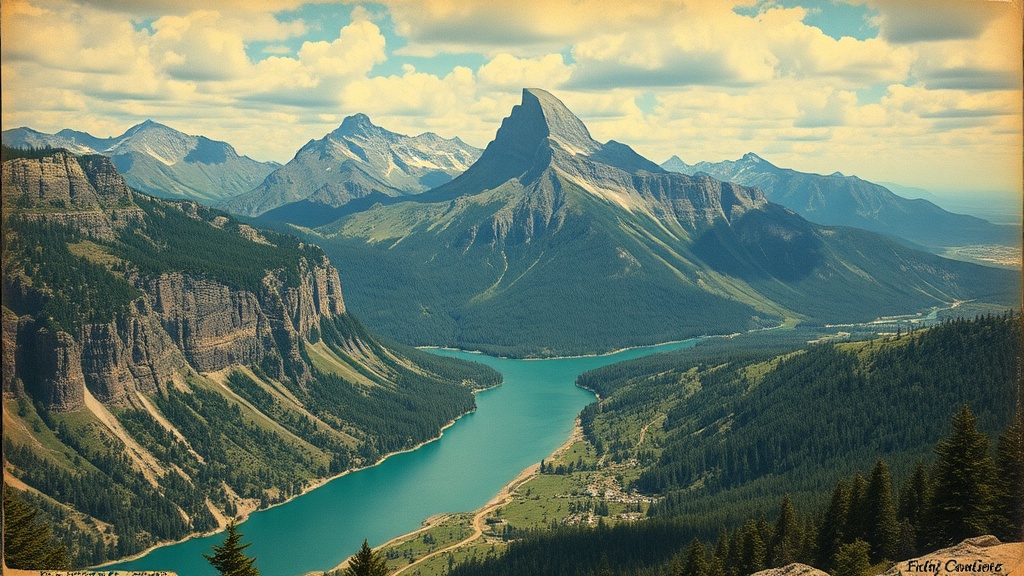
Famous Landscapes Captured on Vintage Postcards

The Grand Canyon's Golden Era
European Alpine Vistas
The Majesty of the Nile River
What Makes Vintage Landscape Postcards Valuable?
This post examines the specific types of vintage landscape postcards that hold significant value for collectors, focusing on the technical production methods and the specific geographic locations that drive demand. You'll find a breakdown of why certain views—like the Grand Canyon or the Swiss Alps—became staples of the postcard industry and how to identify the high-quality prints that collectors actually want.
Collectors often hunt for more than just a pretty picture. They look for specific eras of printing, such as the Linen Era or the Real Photo era. If you're looking for something with real substance, you need to know the difference between a mass-produced souvenir and a high-fidelity piece of print history.
A high-quality landscape isn't just about the view. It's about the lithography. The way the colors interact with the paper stock can make or break the value. For example, a lithographic print from the early 1900s has a depth that modern digital reprints simply can't replicate. It's a tactile history of how we viewed the world before high-definition photography took over everything.
What are the most collectible landscape views?
The most collectible landscape postcards feature iconic, unobstructed views of natural wonders or highly developed, "golden age" cityscapes. Collectors generally prioritize three categories: National Parks, European Alpine scenery, and the American West.
The American West is a heavy hitter here. Postcards showing the Grand Canyon, Yosemite, or Yellowstone are perennial favorites. These weren't just pieces of mail; they were advertisements for the burgeoning automobile culture of the 1920s and 30s. People wanted to show off that they had actually reached these remote, beautiful places.
In Europe, the focus shifts toward the Alps and the Mediterranean coast. A vintage postcard of the Amalfi Coast or a Swiss mountain village carries a certain prestige. These often feature much more sophisticated color palettes than the more vibrant, almost garish colors found in American linen cards. If you're hunting for these, look for the "Real Photo Postcard" (RPPC) designation. These are actual photographs developed onto postcard-sized paper, making them much rarer than mass-produced colorized cards.
The following list breaks down the three most common styles of landscape postcards found in high-end collections:
- The Golden Age (Pre-1915): These are often highly detailed, hand-colored, or lithographic cards. They focus on the "sublime" nature of the world.
- The Linen Era (1930s-1950s): These are characterized by a heavy, textured paper surface that looks like fabric. The colors are incredibly bright—sometimes almost neon—and they depict the "modern" wonders of the world.
- Real Photo Postcards (RPPC): These are the gold standard. They are actual photographic prints. There is no "printed" look here; it's a true photographic reproduction.
If you're unsure about the physical state of your finds, you should check your postcard edges for damage before investing heavily in a lot. A beautiful landscape doesn't matter if the corners are frayed or the edges are bumped.
How can you identify high-quality landscape prints?
You identify high-quality landscape prints by examining the paper texture, the ink saturation, and the absence of "dot patterns" common in cheaper printing.
One of the biggest tells in the vintage world is the presence of a halftone pattern. If you look at a cheap, modern reproduction under a magnifying glass, you'll see a grid of tiny dots. A true vintage lithograph or a high-quality RPPC won't have that same mechanical look. The colors will feel more integrated into the paper. It's a subtle difference, but once you see it, you can't unsee it.
Another way to check quality is through the paper stock. Many collectors focus heavily on identifying linen vs. smooth stock because the texture tells you everything about the era and the intended audience. A linen card has a distinct-looking "weave" that was meant to make colors pop. If the card feels too smooth or "plastic-y," it might be a modern reprint masquerading as a vintage piece.
| Feature | Linen Postcard | Real Photo (RPPC) | Modern Reprint |
|---|---|---|---|
| Texture | Fabric-like, textured | Smooth, photographic paper | Glossy or standard cardstock |
| Color Style | Vibrant, saturated | Natural, realistic tones | Uniform, digital look |
| Detail | Stylized/Artistic | Highly detailed/Sharp | Often lacks depth |
It's also worth noting that the back of the card is just as important as the front. A "divided back" (where the back is split into a message area and an address area) was a major standard change in the early 1900s. If you find a landscape card with an undivided back, you're looking at a much older, often more valuable piece of history.
Why does the era of the postcard matter for value?
The era determines the scarcity and the specific printing technology used, which directly dictates the market value of the landscape depicted.
The "Golden Age" of postcards (roughly 1900 to 1915) is a peak era for landscape collectors. During this time, the world was expanding, and the postcard was the primary way people shared their travels. Because these were often produced in smaller batches than the mass-market cards of the 1940s, the scarcity is higher. You'll often see these with beautiful, hand-tinted colors that give the landscape a dreamlike, painterly quality.
Then you have the mid-century boom. These are the cards that everyone remembers—the ones with the bright, saturated colors of the American West. While they are more common, they have a huge nostalgic pull. They represent a specific time in American history: the rise of the road trip and the celebration of the National Parks. The value here isn't just in the rarity, but in the cultural icon status of the image itself.
If you are serious about building a collection, you need to understand the rare postcard eras. Some eras are much harder to find in "mint" condition because the paper used was often quite acidic and prone to yellowing. A landscape card that has survived 100 years without significant foxing (those little brown spots) is a prize.
A quick tip for the field: always look at the light. If you hold a landscape card up to a light source, you can often see the fiber of the paper. If the light passes through a very even, dense sheet, it's likely a modern production. If it has a certain "tooth" or irregular density, you're likely looking at a true vintage piece.
Don't forget to check your storage. If you've already started a collection of these beautiful vistas, make sure you are selecting proper storage solutions. A beautiful view of the Swiss Alps isn't worth much if it's been ruined by humidity or poor handling.